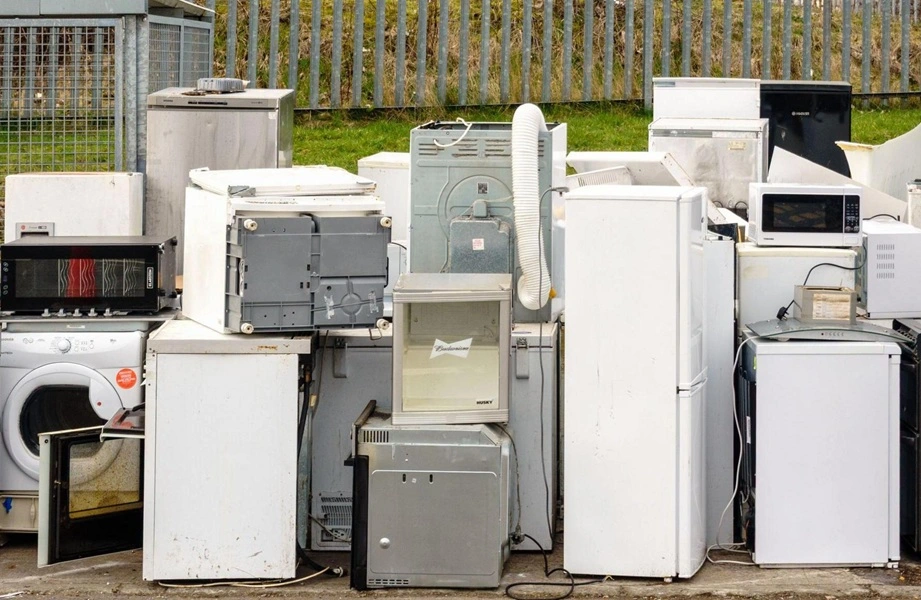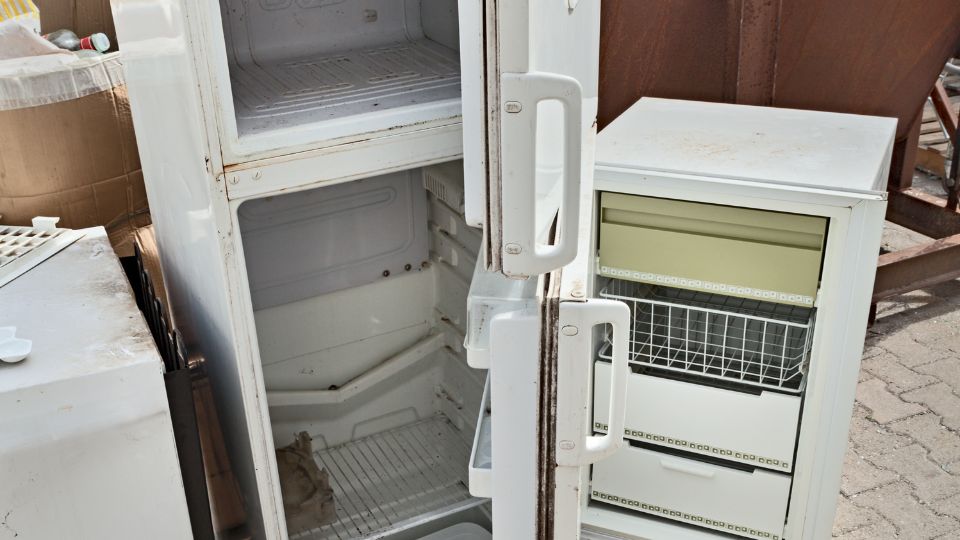
our old fridge has had its time.
Maybe it stopped keeping things cold. Maybe you upgraded to an American-style model. Or maybe you are renovating the kitchen and the new layout means it simply will not fit.
Whatever the reason — you cannot just wheel it to the kerb.
Fridges are one of the most tightly regulated household items to dispose of in the UK. They contain refrigerant gases that are legally required to be extracted by trained professionals. They also contain foam insulation that holds gases from the manufacturing process. Get it wrong and you are breaking the law.
The good news? You have several options. Some are free. Some are fast. And if you play it right, you might even get a little money back.
This guide covers every legal route for fridge disposal in the UK in 2026 — from the free tip run to same-day professional collection. We cover all fridge types: standard freestanding, mini fridge, wine cooler, American-style, and integrated.
Why Fridge Disposal Is Different to Other Appliances
Most appliances — washing machines, cookers, dishwashers — are just WEEE waste. Important to dispose of correctly, but not especially hazardous.
Fridges are different. Here is why.
Refrigerant gases. Every fridge contains a refrigerant — the gas that makes the cooling system work. Older fridges (roughly pre-2000) used CFCs and HCFCs. These gases damage the ozone layer and are up to 10,000 times more potent than CO2 as a greenhouse gas. Newer fridges use HFCs or hydrocarbon refrigerants like R600a, which are still potent greenhouse gases even if they are less ozone-depleting.
If these gases are released into the atmosphere — by cutting, crushing, or puncturing the cooling circuit — the environmental damage is significant. That is why refrigerant removal requires certified professionals under the UK’s F-gas Regulations.
Insulating foam. The foam packed inside the walls and door of most fridges was expanded during manufacturing using blowing agents — often CFC or HCFC gases. Even if the refrigerant circuit is intact, shredding or crushing the appliance releases those gases from the foam.
The legal implication. Under UK WEEE Regulations and the Environmental Protection Act 1990, fridges must be disposed of through licensed facilities equipped to safely extract refrigerant and process the foam. This is not just good practice. It is the law.
This is why you cannot put a fridge in a skip, leave it on the pavement, or take it to a general waste facility. And it is why fridge disposal often costs slightly more than other appliances — the process requires more specialist handling.
Can You Put a Fridge in a Skip or Regular Bin?
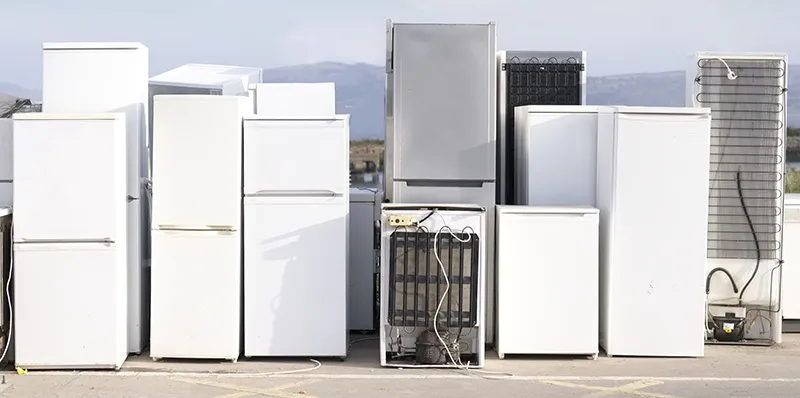
No. Neither option is legal.
Regular bins do not accept fridges. Refuse collectors will not take them. They are too large and contain hazardous materials that require separate processing.
Standard skips do not accept fridges either. Most skip hire companies explicitly exclude refrigeration appliances from their permitted waste lists. The refrigerant and foam insulation make them a specialist item. If you load a fridge into a general skip without prior agreement, you risk being charged an additional fee or having the skip refused altogether.
Leaving it outside is even worse. Placing a fridge on a public pavement, in a communal area, or on the street without an arranged collection is fly-tipping. It is a criminal offence under the Environmental Protection Act 1990. Fixed penalty notices start at £400. Prosecution can result in an unlimited fine.
The right route is one of the options below. Several of them are free.
What Type of Fridge Do You Have?
The disposal process is the same for all fridge types — but knowing your type helps when getting a quote or booking collection.
Standard Freestanding Fridge
A standard fridge without an integrated freezer. Typically 50–70 cm wide, 80–180 cm tall, and 50–80 kg. The most common type in UK homes. All disposal routes below apply.
Under-Counter or Larder Fridge
Shorter and lighter (typically 40–60 kg) than a full-height fridge. Usually fits under a kitchen counter. All disposal routes apply.
Mini Fridge
Mini fridges (also called compact fridges or bar fridges) still contain refrigerant gas. Just because they are small does not mean they can go in the bin or a skip. They are covered by WEEE regulations in exactly the same way as full-size fridges.
Most HWRCs and collection services accept mini fridges. They are easier to transport than full-size models, so the HWRC tip run is particularly practical for mini fridges.
Wine Cooler or Drinks Chiller
Wine coolers and drinks fridges use the same refrigerant-based cooling systems as standard fridges. They must be disposed of through licensed channels. Most wine cooler disposal costs slightly less than a full-size fridge due to their smaller size and weight.
American-Style Fridge Freezer
American-style models are wide (typically 80–100 cm), heavy (80–130 kg), and often contain two separate cooling circuits. They require extra care during removal — most council bulky waste services will not collect them due to their weight. Professional removal is usually the most practical option.
These were covered in detail in our fridge freezer disposal guide, but all routes below apply.
Integrated or Built-In Fridge
An integrated fridge is fitted inside a kitchen unit with a matching cabinet door panel attached. Before disposal, the fridge needs to be extracted from the housing — this involves removing the door panel and unscrewing the securing brackets.
Most professional removal teams carry out integrated fridge removal regularly. When booking, always mention it is integrated so the team arrives prepared.
How to Prepare Your Fridge for Collection
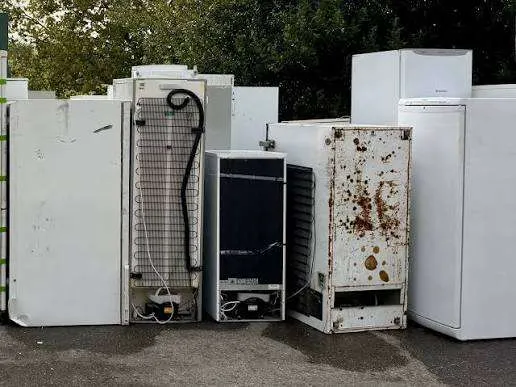
A little preparation makes the collection smoother for everyone.
- Empty it completely.Remove all food, drinks, shelves, and drawers. Check the salad crisper at the bottom — things hide there.
- Switch it off the night before.Turn the fridge off and unplug it 12–24 hours before collection. This gives the refrigerant system time to settle at room temperature.
- Leave the door slightly open.This prevents mould building up while the fridge sits waiting for collection. A folded cloth between the door and the seal works well.
- Mop up any water.As the fridge warms up, condensation may form inside. Have an old towel ready to wipe down the interior.
- Keep it upright.Never lay a fridge on its side for transport unless absolutely necessary. If it does go on its side, leave it upright for at least 24 hours before restarting — or let the collection team know.
- Clear a path.Move any chairs, mats, or obstacles between the fridge and the front door. The collection team handles the heavy lifting, but a clear path protects your floors and walls.
Option 1 — Household Waste Recycling Centre (The Tip)
Taking your fridge to your local Household Waste Recycling Centre (HWRC) is free. Every UK council runs at least one HWRC that accepts fridges.
The site will have a dedicated bay for fridges and freezers — separate from general WEEE — because of the specialist handling required. Staff will direct you when you arrive.
This is the cheapest route if you have access to a van or a large estate car. A standard fridge weighs 50–80 kg, so you will need help lifting it.
Before you go:
- Check whether your local HWRC requires advance booking. Many now do — especially following the 2026 Simpler Recycling reforms.
- Search “[your area] + household waste recycling centre” or use the Recycle Now locator at recyclenow.com.
- Some HWRCs have annual visit limits — check if this applies in your area before using up a slot.
- Commercial vehicles may not be permitted at domestic HWRC sites.
- Proof of local residency may be required (driving licence or utility bill).
Getting there without a car:
This is the most common problem. If you do not have access to a suitable vehicle, the HWRC free route is not practical. In that case, council collection, retailer take-back, or a professional service is more realistic.
Option 2 — Council Bulky Waste Collection
Most UK councils offer a bulky waste collection for large household items including fridges.
You book in advance, pay a fee in most areas, and leave the fridge at the kerbside on the collection day. The council team collects it and takes it to a licensed facility.
2026 pricing examples:
- Hackney Council — £15 for up to 5 bulky items (fridges included)
- Westminster — £31 for up to 6 items
- Wolverhampton — £26.50 per electrical item
- North Yorkshire — free at household waste recycling centres
- Sheffield — one free collection per year for council tenants (up to 12 items)
Around 26 UK councils offer free bulky waste collection. Most charge between £15 and £60. Check your local authority’s website for current pricing and booking.
Limitations:
- Waiting times are typically 1–4 weeks — often longer for fridges
- You must leave the fridge at the kerbside — teams will not enter your home
- American-style fridge freezers may not be accepted due to their weight
- Only available to council tax payers registered in that local authority area
If you need your fridge removed quickly or from inside your home, a professional service will be faster.
Option 3 — Retailer Take-Back Scheme
Buying a new fridge? You are legally entitled to have your old one collected by the retailer under the UK’s WEEE “one for one” take-back scheme.
When you purchase a new fridge, the retailer must offer to collect your old one at no extra charge — or tell you where you can take it for free. Some retailers build the collection into the delivery, while others charge a small fee.
Retailers that typically offer this:
- Currys — old appliance removal available as a paid add-on at checkout
- AO.com — collects old fridges on delivery day; charges apply
- John Lewis — removal included with some delivery options
- Argos — take-back available when purchasing a new fridge
- B&Q — take-back on kitchen appliance purchases
Things to confirm when booking:
- Is the old fridge defrosted and accessible? Most retailers require this.
- Is there clear access? Some have restrictions on stairs or tight hallways.
- Is your old fridge an integrated model? Let them know in advance — some delivery teams will not handle integrated fridge extraction.
If you are already buying a new fridge, always ask about take-back. It is often the cheapest option.
Option 4 — Professional Fridge Removal Service
A professional removal service is the fastest and most convenient option. You book, they arrive — often the same day — and remove the fridge from wherever it is in your home.
What a good service includes:
- Collection from anywhere in your property — kitchen, utility room, garage, upstairs, or basement
- Two-person team handling all the heavy lifting
- Specialist handling of refrigerant — transported to a licensed WEEE facility
- Waste transfer note as legal proof of responsible disposal
- Working fridges assessed for donation to charity before recycling
Scrap My Appliance handles fridge disposal across the UK for domestic and commercial properties. We collect standard fridges, mini fridges, wine coolers, under-counter larder fridges, and integrated models. Same-day and next-day slots are available in most areas, including across all London boroughs.
If you also have a washing machine, cooker, or dishwasher to remove at the same time, we collect everything in one visit — usually at a lower per-item rate.
When professional removal makes the most sense:
- You need it gone quickly (same day or next day)
- You do not have a vehicle large enough to transport it
- Your fridge is upstairs, integrated, or in a difficult-to-access space
- You are a landlord clearing a property between tenancies
- You need a waste transfer note for business compliance
Call us free on 0800 599 9003 or get an instant quote online.
Option 5 — Donate or Sell It
If your fridge still works, getting it a second life is the most environmentally responsible option.
Donation options:
- British Heart Foundation — collects working fridges from many UK areas for free
- Local furniture reuse networks — often accept working fridges for families in need
- Freecycle and Freegle — list it free and someone in your area will come and collect
- Facebook Marketplace (free listings) — highly effective for working appliances in urban areas
Selling options:
- eBay (local collection listings — avoids the impossible task of couriering a fridge)
- Gumtree
- Facebook Marketplace
- Local Facebook community groups
A working fridge in decent condition can sell for £30–£120 depending on brand, age, and size. A working American-style fridge in good condition can fetch significantly more — £150–£400+ for popular brands.
When listing, be honest. State the age, brand, any faults, and approximate dimensions. Include clear photos with good lighting. If the fridge has been well maintained and the seals are in good condition, say so — buyers appreciate the detail.
How Much Does Fridge Disposal Cost in the UK?
Here is a full 2026 breakdown:
|
Disposal Method |
Typical Cost |
|
Household Waste Recycling Centre (tip) |
Free — you transport |
|
Council bulky waste collection |
Free–£60 (varies by council) |
|
Retailer take-back (with new purchase) |
Free–£40 |
|
Donate or sell (working fridge) |
Free — may earn money |
|
Professional removal service |
£45–£100 |
|
American-style fridge — professional |
£70–£130 |
|
Mini fridge or wine cooler |
£30–£60 |
Factors that affect professional removal costs:
- Location — London and South East prices run 20–30% higher than the rest of the UK
- Access — upstairs rooms, narrow Victorian hallways, or no-lift flats add a small surcharge
- Size and weight — American-style and large American fridge freezers cost more due to their weight
- Combined collection — booking a fridge alongside other appliances reduces the per-item cost
For a fixed, upfront quote with no hidden charges, call Scrap My Appliance on 0800 599 9003 or get a quote online.
See our full appliance removal cost guide for a complete 2026 breakdown of UK disposal prices.
What Happens to Your Fridge After Collection?
When your fridge reaches a WEEE-licensed recycling facility, this is the process:
Step 1 — Assessment. If the fridge still works, it is assessed for refurbishment or charity donation before any recycling takes place.
Step 2 — Refrigerant extraction. A certified operative uses specialist pump equipment to remove the refrigerant gas from the cooling circuit. This is done in an enclosed system so no gas escapes into the atmosphere. The gas is then either recycled or destroyed using high-temperature incineration.
Step 3 — Oil removal. The compressor contains oil that may have dissolved refrigerant in it. This is extracted and processed separately.
Step 4 — Foam processing. The insulating foam is shredded in a sealed chamber. Any residual CFC or HCFC gases trapped in the foam from manufacturing are captured and destroyed.
Step 5 — Component dismantling. The compressor, motor, wiring, shelving, and door seals are removed and separated.
Step 6 — Shredding and material recovery. The steel casing goes to a steel mill. The copper from the compressor and wiring goes to copper smelters. Aluminium components are separately recovered. Plastic parts go to plastics reprocessors.
Over 95% of a standard fridge’s weight can be recovered and recycled when processed correctly. Choosing a licensed service ensures the full process is carried out legally and responsibly.
FAQs
Can I put a fridge in a skip?
No. Fridges contain refrigerant gases and foam insulation with blowing agents — both of which are regulated substances under UK law. Standard skip hire companies exclude fridges from their permitted waste lists. Some specialist WEEE providers can arrange a separate refrigeration collection alongside skip hire, but this must be agreed in advance and priced separately.
Can I take a fridge to the tip?
Yes. Your local Household Waste Recycling Centre (HWRC) will accept fridges for free. Look for the refrigeration appliances bay, which is separate from the general WEEE area. You will need your own vehicle (or a van) and someone to help you lift it.
How do I dispose of a fridge for free in the UK?
Free options include: taking it to your local HWRC yourself, using a retailer take-back scheme when buying a new fridge, listing it on Freecycle or Facebook Marketplace if it still works, or checking whether your council offers a free bulky waste collection (around 26 UK councils do).
Does Currys take old fridges?
Yes. Currys offers old fridge collection as a paid add-on when you purchase a replacement. The delivery team removes your old fridge on the same visit. Confirm the price and access requirements when booking.
How much does fridge disposal cost in the UK?
Taking it to the tip yourself is free. Council collection costs between free and £60 depending on your local authority. Professional collection starts from £45 for a standard fridge, or £70+ for American-style models. See our appliance removal cost guide for full 2026 pricing.
What happens to a fridge when it is recycled?
The refrigerant gas is extracted first by certified operatives using specialist equipment. The foam insulation is then processed in a sealed chamber to capture any trapped gases. The steel, copper, aluminium, and plastic components are separated and sent to the appropriate recycling streams. Over 95% of materials in a standard fridge can be recovered.
Is it illegal to leave a fridge outside?
Yes. Leaving a fridge on a public pavement, in a communal area, or on the street without an arranged collection is fly-tipping under the Environmental Protection Act 1990. Fixed penalty notices start at £400 and prosecution can result in an unlimited fine.
Can I get rid of a fridge without a car?
Yes. If you cannot transport the fridge to a HWRC yourself, book a professional collection service. Same-day fridge removal is available across most of the UK. Scrap My Appliance can collect from any floor, any room, any access type — including upstairs flats, basement kitchens, and narrow hallways. Call 0800 599 9003 or book online.
What refrigerant is in my fridge?
Check the label on the back or inside the door of your fridge. Common modern refrigerants are R134a and R600a (isobutane). Older fridges (pre-2000) may contain R12 or R22 — these are CFCs and HCFCs that are particularly hazardous and require specialist handling. Whatever the type, the refrigerant must be extracted by a certified professional before the fridge can be recycled.
Can I dispose of a fridge and other appliances at the same time?
Yes — and it usually works out cheaper per item. Scrap My Appliance regularly collects fridges alongside washing machines, dishwashers, cookers, and tumble dryers in a single visit. Booking multiple appliances together reduces the per-item rate.
Ready to Get Rid of Your Old Fridge?
Scrap My Appliance is a WEEE-licensed appliance removal and recycling service covering homes and businesses across the UK.
We collect all types of fridges — standard, mini, wine cooler, under-counter, American-style, and integrated. Same-day and next-day collection available in most areas. Prices agreed upfront with no hidden fees.
Working fridges in good condition go to our UK charity network. Every fridge is recycled responsibly. You receive a waste transfer note with every collection.
Call free: 0800 599 9003